What GB/T Standards Must Thermal Shock Test Chambers Comply With?
Author:LINPIN Update Time:2026-07-09 Source:LINPINIn today's competitive landscape, product quality and reliability are non-negotiable. Thermal shock testing—which evaluates how products withstand rapid, extreme temperature changes—is a critical gatekeeper in the journey from R&D to market. But to ensure valid, repeatable results, the test chambers themselves must meet stringent national standards. So, which GB/T standards specifically govern thermal shock test chambers?
This article cuts through the complexity and focuses on the core GB/T 2423 "Environmental Testing" series, giving you a clear, practical guide to the key standards that ensure your equipment—and your quality assurance—is fully compliant.
The Primary Benchmark: GB/T 2423.22
The most direct and essential standard for thermal shock test methods and equipment performance in China is:
GB/T 2423.22-2012 – Environmental Testing – Part 2: Test Methods – Test N: Change of Temperature
This standard is identical to the international IEC 60068-2-14 and lays out the general principles for temperature-change testing. It includes two critical sub-methods that define thermal shock:
-
Test Na: Rapid change of temperature with specified transition time (the true "shock" scenario)
-
Test Nb: Change of temperature with specified rate of change
Crucially, this standard specifies the performance requirements that a compliant chamber must meet, including:
-
Temperature ranges for both hot and cold zones
-
Transfer time (typically ≤ 5 minutes) to ensure the sample experiences a genuine "shock" rather than a gradual ramp
-
Temperature recovery time
-
Temperature stability and uniformity
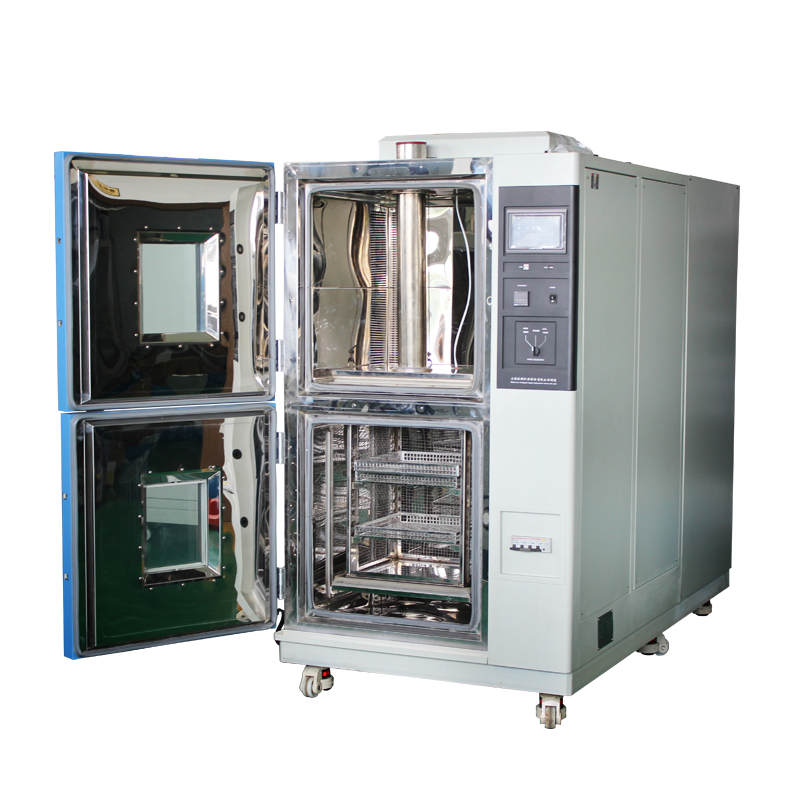
A properly designed thermal shock test chamber must be built to satisfy these strict requirements for transition speed and thermal recovery.
Foundational Equipment Standards: GB/T 10592 & GB/T 10586
Beyond the test method itself, thermal shock chambers—as specialized environmental chambers—must also comply with these two foundational product standards:
GB/T 10592-2023 – Specification for High and Low Temperature Test Chambers
This standard (which replaced the 2008 edition) is the core product specification governing the design, manufacture, and acceptance of high/low temperature chambers, including thermal shock models. It covers:
-
Definitions and nomenclature
-
Operating conditions
-
Technical requirements (temperature range, uniformity, fluctuation, heating/cooling rates)
-
Safety and reliability criteria
-
Test methods and inspection rules
Any compliant chamber must pass the performance tests defined in this standard.
GB/T 10586-2006 – Specification for Damp Heat Test Chambers
Although thermal shock testing primarily focuses on temperature, some chambers (e.g., two-zone systems where the hot zone also supports humidity) incorporate humidity functionality. This standard sets the performance requirements for the humidity-related aspects, making it a key reference for assessing overall environmental simulation capability.
Related Application-Specific Standards
In real-world product validation, thermal shock testing is often combined with other environmental tests, and may be referenced by industry-specific standards such as:
-
GB/T 4937 – Mechanical and climatic test methods for semiconductor devices
-
GB/T 14710 – Environmental requirements for medical electrical equipment
-
GJB 150A – Laboratory environmental test methods for military equipment
While these standards address specific product categories, the temperature-shock test methods they reference ultimately trace back to the core requirements of GB/T 2423.22, ensuring consistency and comparability across industries.
When it comes to thermal shock testing, every detail matters. A chamber built in strict compliance with GB/T 2423.22, GB/T 10592, and related standards is not just another piece of lab equipment—it is the foundation of a robust product reliability program and a key driver of customer confidence. Choosing compliant equipment is a commitment to quality that pays off throughout the product lifecycle.